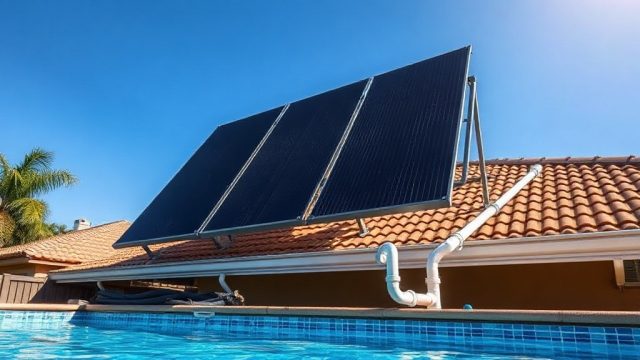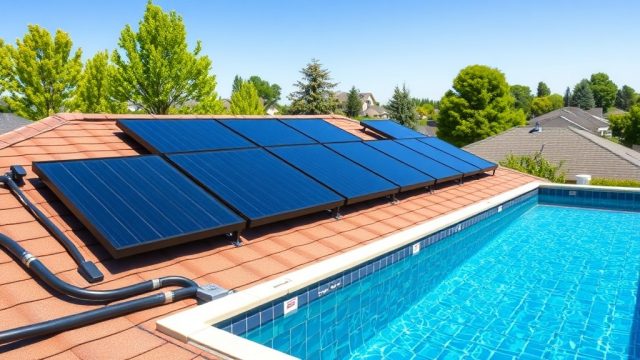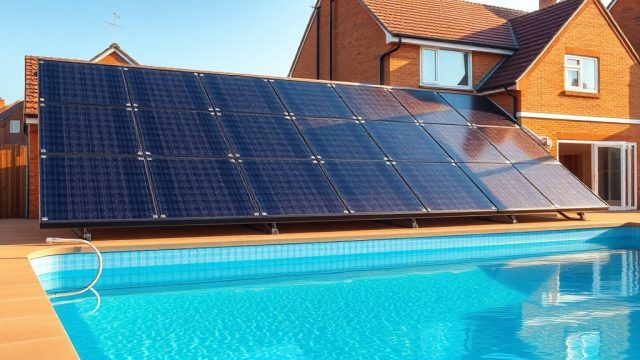
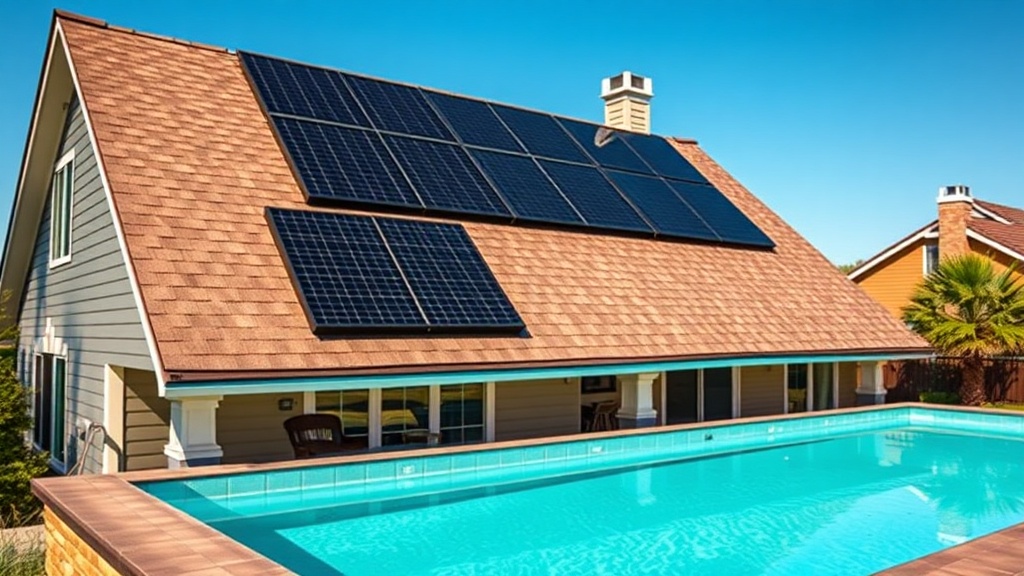
Choosing the right number of Fafco Solar Bear panels for your pool isn’t just a math problem—it’s about balancing sun exposure, pool volume, and realistic heating goals. Oversizing wastes money and roof space, while undersizing leaves you with chilly water on cool evenings. This guide walks you through the exact calculations and real-world trade-offs so you can order with confidence.
What Is the Standard Sizing Rule for Fafco Solar Bear Panels?
Industry best practice says you need at least 50% to 70% of your pool’s surface area in solar collector area, but that’s a starting point. For Fafco Solar Bear panels, each panel typically measures 4 ft x 10 ft (40 sq ft of absorber area). If your pool is 16 ft x 32 ft (512 sq ft), you’d need between 6 and 8 panels to hit the 50–70% target. Warmer climates can lean toward the lower end; cooler climates or pools with heavy shade should aim for 70% or more.
But don’t ignore roof orientation. South-facing roofs at a 30–45° tilt capture maximum sun. If your panels face east or west, you may need to add 10–20% more panels to compensate for lower daily insolation. Also factor in panel spacing—Fafco’s manifolds require at least 6 inches between rows for airflow under the panels, which slightly reduces effective coverage.
A quick formula: Pool length (ft) x width (ft) = surface area. Multiply by 0.6 (the 60% middle ground) to get target collector area. Divide by 40 (sq ft per Fafco panel) to get panel count. For a 512 sq ft pool: 512 x 0.6 = 307 sq ft. 307 ÷ 40 = 7.7 panels → round to 8 panels.
How Does Your Pool’s Volume Change the Panel Count?
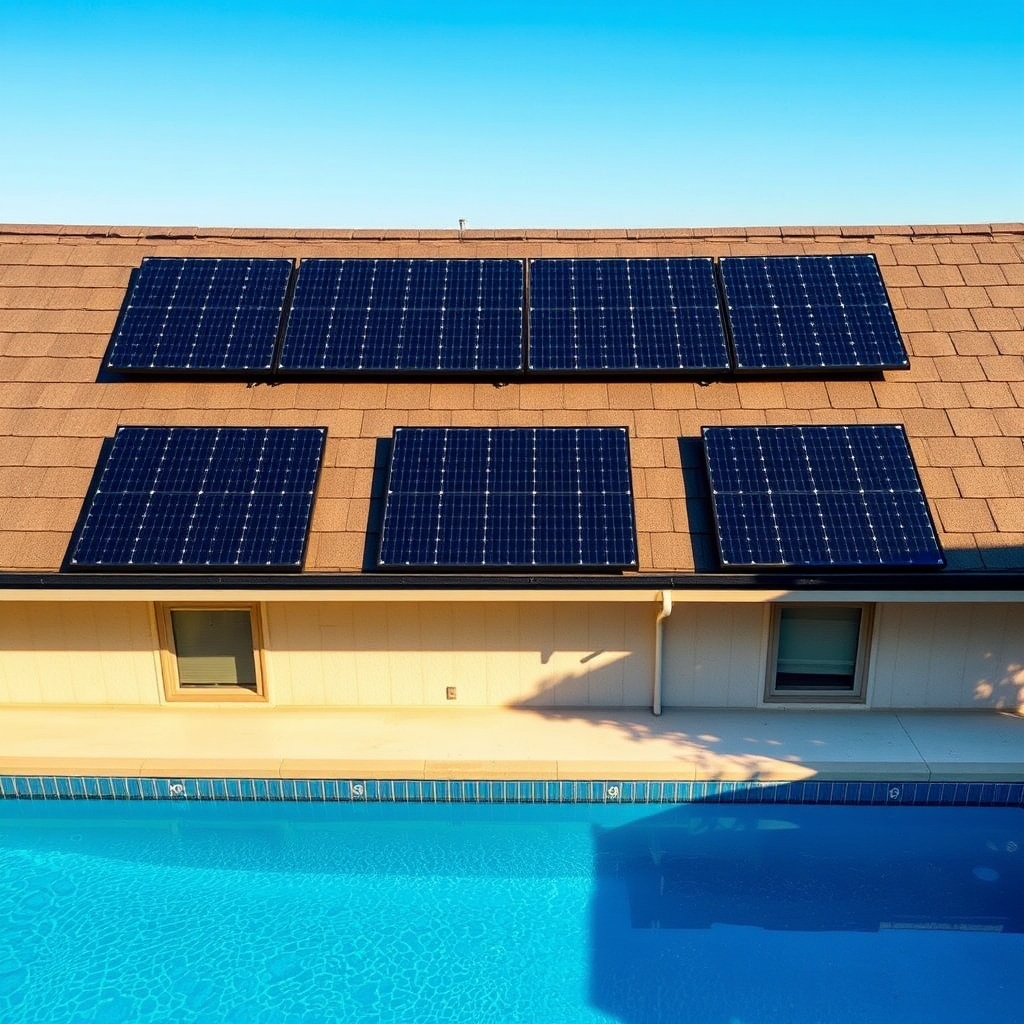
Surface area matters most for catching sun, but water volume determines how much heat you need to raise the temperature. A 512 sq ft pool that’s only 3 ft deep (shallow play pool) holds about 11,500 gallons, while the same surface at 6 ft deep holds 23,000 gallons. That doubling of water mass requires a roughly 30% increase in collector area to achieve the same temperature rise.
Run this volume check: Pool length x width x average depth (all in feet) x 7.48 = gallons. For a 16 x 32 pool averaging 5 ft deep: 16 x 32 x 5 x 7.48 = 19,148 gallons. Using the rule of thumb of 1 sq ft of collector per 10–15 gallons of water: 19,148 ÷ 12 (midpoint) = 1,596 sq ft needed? That’s obviously far too high because solar heating isn’t sized linearly like gas heaters. The surface-area rule (50–70%) is more reliable for Fafco panels, but volume matters for fine-tuning. A deeper pool (+20% additional water) might need +1 panel beyond the surface-area recommendation.
Also consider your desired temperature lift. If you’re in Phoenix and only want to raise the water from 70°F to 80°F, the standard 60% rule works fine. But if you’re in Seattle aiming for a 20°F rise, calculate using a solar fraction closer to 80% of pool surface area.
What Roof Constraints Affect How Many Panels You Can Install?
Fafco Solar Bear panels need a flat, uninterrupted space on a south-to-west facing roof section. Each panel weighs about 45 lbs dry and 65 lbs when water-filled, so roof load isn’t usually a problem, but obstructions like chimneys, vents, and plumbing stacks can break up your layout. Each panel requires roughly 40 sq ft plus 6 inches of clearance around all sides for airflow and maintenance access.
Measure your usable roof area, not just total roof area. A standard 1,500 sq ft roof might have only 300–400 sq ft of unobstructed south-facing deck. If that space can only fit 6 panels, you’ll need to decide: stick with 6 panels and accept slower heating, or split the array across east and west roof planes (adding +15% panels for directional inefficiency). Fafco panels can be manifolded in series or parallel, but mixing roof planes often requires extra plumbing and a Fafco Solar Bear Controller to balance flow—check the Fafco Solar Bear Solar Controller Settings Guide for proper pump scheduling.
Don’t forget local building codes and HOA rules. Many municipalities require solar collectors to be at least 3 ft from ridge lines and valleys, and some HOAs restrict panel height above the roof plane. Measure twice, order once.
What if You Have a Pool Cover or an Inflatable Solar Blanket?
A dark blue or black solar cover drastically reduces heat loss at night, which means your Fafco Solar Bear array can be 10–15% smaller while still achieving the same average pool temperature. The cover traps heat, so the panels don’t have to work as hard to recover overnight temperature drops. If you use a cover most nights during the swimming season, you can comfortably size at 50% surface area instead of 60%.
Conversely, if you never use a cover, the panels must replace 4–8°F of nightly heat loss. That extra demand pushes the recommendation toward 70–80% of pool surface area. In a side-by-side test on a 20,000-gallon pool: 6 panels with a cover (50% surface area) performed similarly to 8 panels without a cover (60% surface area) in terms of reaching 83°F on a sunny day.
If you’re adding panels later, it’s easy to expand a Fafco system—the manifolds accept add-on panels without draining the whole system. But it’s cheaper to get the count right upfront.
Should You Size for Peak Summer or Shoulder Seasons?
Most pool owners only care about water temperature from April to October. But if you want to swim in March or November, you need to oversize the array. In cooler shoulder months, the sun is lower and days are shorter, so you get about 40% less solar energy per day. To achieve the same 82°F water in April as you get in July, add 30–40% more collector area.
Example: A pool in Maryland that uses 6 panels (60% coverage) can maintain 80–82°F from June through August. To swim comfortably in late April and early October, that same pool needs 9 or 10 panels (90–100% coverage). This oversizing also helps on cloudy days—extra panels capture more diffuse light. If you have a gas backup heater, you can size for summer only and use gas to bridge the cold weeks. But if you want a fully solar-heated pool for a longer season, budget for the larger array upfront.
For a seasonal approach, the Fafco Solar Bear Roof Mounting Kit installation is easily scalable if you leave room for future expansion. Most roof kits allow you to bolt on an extra row later.
| Panel Count (40 sq ft each) | % of Pool Surface Area (512 sq ft pool) | Typical Use Case |
|---|---|---|
| 5 panels | 39% | Minimalist: only for very warm climates or with a cover |
| 6 panels | 47% | Budget-friendly: adequate in sunbelt states with a cover |
| 8 panels | 63% | Sweet spot for most pools in moderate climates |
| 10 panels | 78% | Aggressive heating: for cool climates or long shoulder seasons |
| 12 panels | 94% | Maximum: for year-round use or large water volume (20,000+ gallons) |
Notice the jump from 6 to 8 panels represents a 33% increase in cost but roughly a 25°F improvement in temperature lift on a 70°F day. It’s not linear, but the marginal gain is real.
What Do Owners Say About Sizing Fafco Solar Bear Panels?
Real-world feedback from pool forums and review sites reveals two common sizing patterns. First, many owners wish they had gone one or two panels larger than the “50% rule” suggested. A typical comment: “I put eight panels on my 16×32 in-ground pool in Texas. It works great in July, but in May and September it barely hits 80°F. I should have gone with ten.”
The second insight is about roof orientation. “My panels face west because that’s all we had free. I thought the 60% rule would be fine, but the water only gets to 76°F on sunny days. I added two more panels and now it’s 82°F. The controller settings mattered a lot too—I had to tweak the differential temperature after reading Fafco Solar Bear Solar Controller Settings Guide.”
Another owner noted that panels worked even with partial shade: “We have a large oak that casts afternoon shade on half the array. We compensated by cleaning the panels weekly and running the pump longer. Still, I wish we’d bought two extra panels to overcome the shade.” These stories reinforce that conservative oversizing (10–20%) is rarely regretted.
Frequently Asked Questions
Can I install Fafco Solar Bear panels myself, or do I need a pro?
Many DIYers install them using the roof-mount kit—it’s a straightforward plumbing project if you have basic tools and can get on the roof safely. However, tying into your existing pool plumbing and setting the controller timing can be tricky. If you’re unsure, hire a pro for the roof penetration seals and wiring. Read the Fafco Solar Bear Roof Mounting Kit: Step-by-Step Installation guide for details.
What happens if I install too few panels?
You’ll see a smaller temperature rise—typically 6–10°F instead of 12–18°F on a sunny day. The system will still operate, but you may need to rely on a backup heater more often. You can add panels later, but only if you left room on the roof and have extra manifolds. Otherwise, you’ll need to drain and reconfigure the plumbing.
Will more panels always make the pool hotter?
Up to a point. There’s a diminishing return once you exceed about 100% of surface area because the water can only get so hot before it loses heat faster than the panels can collect it. In practice, 12 panels on a 512 sq ft pool (94% coverage) might only produce a 1–2°F gain over 10 panels (78% coverage) on a scorching day. The main benefit is faster recovery after cloud cover or overnight cool-down.
How do I know if my roof can support the weight?
Fafco panels weigh about 65 lbs each when full of water. A 10-panel array adds 650 lbs, spread across about 400 sq ft of roof. That’s roughly 1.6 lbs per sq ft—well within typical roof load capacities of 20–30 lbs per sq ft for snow loads. But always check with a structural engineer if you have an older roof (pre-1980s) or unusual framing (trusses on 24-inch centers).
Should I get a heat pump instead of more panels?
The cost per BTU of solar panels is lower over the long term, but the upfront cost of a large array (10+ panels plus installation) can rival a heat pump. If you have unlimited roof space and long sunny seasons, go solar. If your roof is shaded or you need consistent heat in cool weather, a heat pump might be more reliable. Some owners pair a small solar array (4–6 panels) with a heat pump for best of both worlds.
How do I clean Fafco Solar Bear panels?
Use a garden hose with a gentle spray attachment—no pressure washers, which can damage the absorber coating. Clean them every 3–4 months during the season, or more often if you have dusty conditions. Check for leaks at the manifold connections; see our guide on Fix a Leaking Fafco Solar Bear Collector Panel if you find drips.