Why Does Commercial Pool Sizing for SunStar Solar Pool Heaters Demand a Different Approach?
When it comes to heating commercial pools, the stakes are much higher than with residential installations. A hotel, aquatic center, or community association cannot afford downtime or inadequate heating during peak seasons. The SunStar Solar Pool Heater, while a robust choice, requires careful sizing to meet the higher flow rates and surface areas typical of commercial installations. This guide walks through the specific calculations, equipment pairings, and system configurations necessary to ensure a SunStar system delivers consistent, cost-effective warmth for a public or semi-public pool.
For residential comparison, see our guide on Sizing SunStar Solar Pool Heater for Inground vs Above Ground Pools.
How Do I Calculate the Required Square Footage for a Commercial Pool?
Commercial pools generally require a solar collector area equal to 60% to 100% of the pool’s surface area. For a typical 1,000-square-foot commercial pool (e.g., 40 ft x 25 ft), you would need between 600 and 1,000 square feet of SunStar solar collectors. However, this ratio depends heavily on geographic location, desired temperature rise, and exposure.
- Step 1: Measure the pool’s surface area (length × width). For irregular shapes, use the average length × average width.
- Step 2: Determine the desired temperature rise (e.g., from 75°F to 82°F = +7°F).
- Step 3: Multiply surface area by a location factor (1.0 for sunny regions like Arizona, 1.5 for cloudier regions like the Pacific Northwest). Example: 1,000 sq ft × 1.2 = 1,200 sq ft of collectors.
A good rule of thumb for commercial installations: always round up by at least 20% to account for heat loss at night and extended use during shoulder seasons. The SunStar’s modular panels make scaling straightforward.
What Is the Ideal GPM Flow Rate for a SunStar Commercial System?
Water flow is critical for solar thermal transfer. SunStar solar panels perform optimally at flow rates between 4 and 8 gallons per minute (GPM) per 4 ft × 12 ft panel. For a system with 24 panels (covering 1,152 sq ft), the total required flow range is 96 to 192 GPM.
Commercial pool pumps often run at higher horsepower (3–5 HP or more) to achieve these rates. The pump must overcome friction loss from long pipe runs, multiple panel headers, and any elevation changes. A common mistake is undersizing the pump, which leads to stagnant water in the panels and reduced heat output.
For detailed pump matching, read our dedicated guide on SunStar Solar Pool Heater Pump Requirements: GPM Guide.
| Pool Surface Area (sq ft) | Number of SunStar Panels (4×12 ft) | Total Collector Area (sq ft) | Recommended GPM Range | Typical Pump HP (Commercial) |
|---|---|---|---|---|
| 500 | 10 | 480 | 40–80 | 2.0 |
| 800 | 16 | 768 | 64–128 | 3.0 |
| 1,000 | 24 | 1,152 | 96–192 | 4.0 |
| 1,500 | 36 | 1,728 | 144–288 | 5.0–7.5 |
How Does Panel Tilt Angle Affect Commercial Performance Across Seasons?
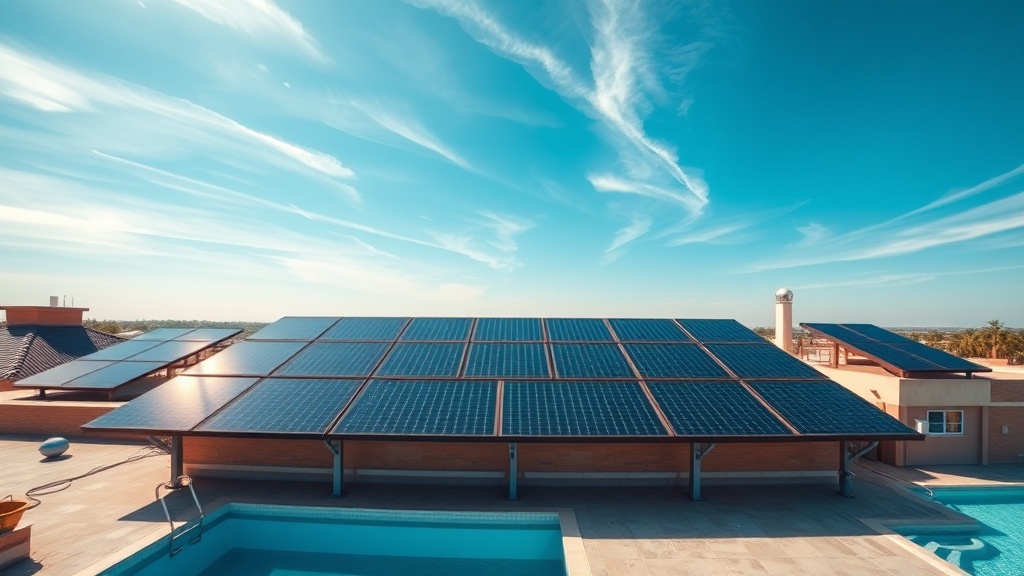
Commercial installations are often on flat roofs, giving flexibility for tilt angle adjustments. For seasonal optimization, the SunStar panels should be tilted at an angle equal to the latitude (for year-round use) or latitude ± 15° (for winter vs. summer bias). In a mid-latitude region like Denver (40° N), winter tilt would be around 55°, and summer tilt around 25°.
Fixed commercial systems typically install at latitude to balance heating across the year. However, if the pool is used heavily in winter (e.g., indoor therapy pools with outdoor collectors), tilting steeper increases low-angle sun capture. This is especially relevant for Optimal Tilt Angle for SunStar Solar Pool Heater: Summer vs Winter Settings.
Panel orientation should face true south in the Northern Hemisphere, with no shading from adjacent structures between 9 a.m. and 3 p.m. A tilt-angle mistake can reduce annual heat output by 20%–30%.
What Are the Key Structural and Piping Considerations for Commercial Roof Mounts?
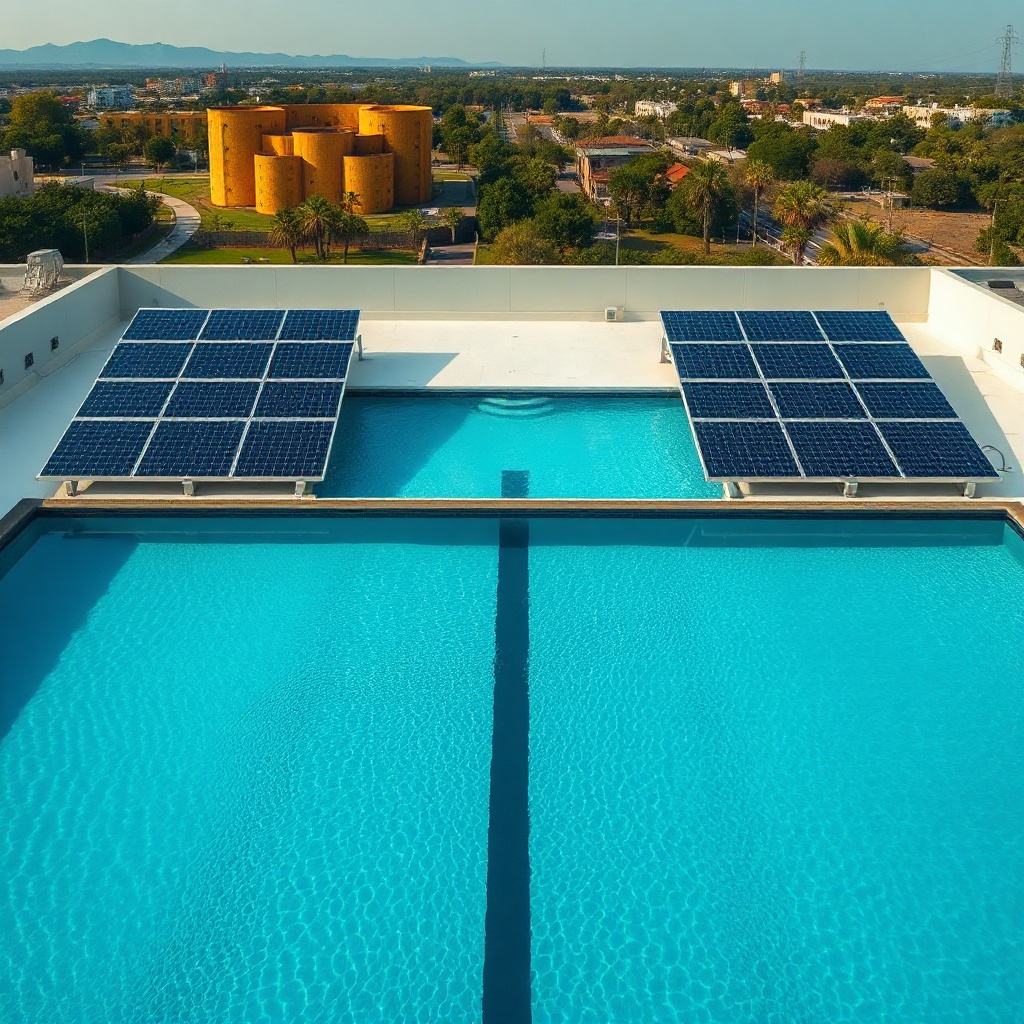
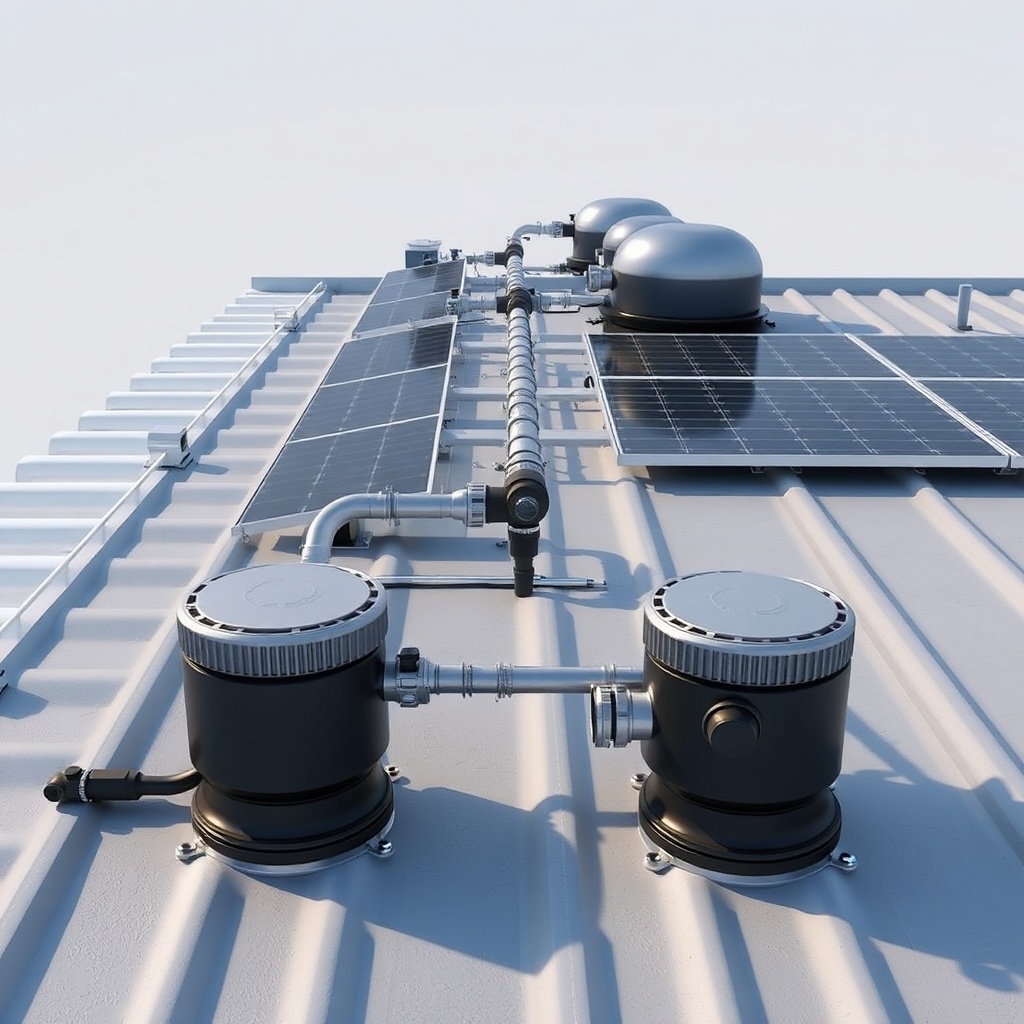
SunStar panels weigh approximately 10–15 lbs per panel (empty) but with water flow can add 40–60 lbs per panel. For a 24-panel system, the dead load is around 1,200 lbs plus 1,440 lbs of water. This must be distributed across the roof structure. A structural engineer should confirm load capacity for the specific roof type (metal, concrete, or membrane).
- Headers: Use 2.5–3 inch schedule 40 PVC or CPVC for main supply and return lines to handle high flow without excessive friction loss.
- Vacuum Breaks: Every commercial system requires vacuum break valves at the highest point to prevent siphon damage during pump shutdown. Install at the top of the supply riser. See SunStar Solar Pool Heater Vacuum Break Installation Guide: Prevent Siphon Damage.
- Freeze Protection: In climates below 40°F, use a freeze control valve that drains panels automatically when temperatures drop. Detailed steps are in Winterizing Your SunStar Solar Pool Heater: Freeze Protection Guide.
What Do Commercial Pool Operators Say About SunStar Heaters?
Feedback from hotel and community pool managers highlights SunStar’s durability and low maintenance. A manager at a Florida resort reported a 35% reduction in gas heating costs after adding SunStar panels to a 1,200 sq ft pool. Another operator in Texas noted that the panels handled high winds (up to 90 mph) without damage when properly secured with ballasts.
However, common constructive feedback includes the need for professional installation regarding flow balancing—multiple panels require careful manifold design to avoid uneven water distribution. One YMCA facility in Ohio shared that after a pump upgrade from 2 HP to 4 HP, their SunStar system heated the 1,000 sq ft pool to 82°F even in October.
Frequently Asked Questions
1. How many SunStar panels do I need for a 2,000 sq ft commercial pool?
At 60% coverage, you need 1,200 sq ft of collectors, equivalent to about 25 panels (4×12 ft). At 100%, it jumps to 42 panels. Consult a solar contractor for precise sizing based on your region.
2. Can I mix SunStar panels with other solar brands?
Mixing is not recommended due to different flow resistances and connector types. SunStar panels have a proprietary manifold system. Always use identical panels for even flow.
3. What is the expected payback period for a commercial SunStar system?
In a sunny region with moderate gas/electric prices, payback typically ranges from 2 to 5 years. Factors include local utility rates, available incentives, and pool usage hours.
4. How often should I clean SunStar panels on a commercial roof?
At least quarterly in dusty environments or near trees. Automatic cleaning systems can be integrated, but manual rinsing with a hose every two months keeps efficiency high.
5. Can the SunStar system be integrated with an existing gas pool heater?
Yes. A bypass valve allows water to flow through solar panels first, then the gas heater acts as a backup. This is common for commercial pools requiring consistent temperature regardless of weather.
6. What maintenance is required after winterizing a commercial SunStar system?
In spring, flush the system with fresh water, check vacuum breaks for debris, inspect seals for cracks, and pressurize to test for leaks before regular use.