Introduction to Matching a Heat Exchanger with Your SunStar Solar Pool Heater System
Selecting the right heat exchanger for a SunStar solar pool heating system is a critical step that directly affects thermal efficiency and long-term operational costs. A mismatched heat exchanger can lead to excessive pressure drop, inadequate heat transfer, or premature wear. This article provides a structured approach for pool owners and installers to size, select, and integrate a heat exchanger that complements the specific flow and thermal characteristics of SunStar collectors.
1. Why Does Heat Exchanger Sizing Matter for a SunStar Solar System?
The heat exchanger acts as the bridge between the solar collector array and the pool water. For SunStar systems, which typically operate with collectors rated at 4 to 6 GPM per panel, the heat exchanger must handle the same flow without causing excessive backpressure. An undersized exchanger reduces flow by increasing friction, while an oversized unit adds unnecessary cost and reduces temperature rise per pass. Commercial installations often require multiple parallel exchanger modules to maintain 4–6 psi pressure drop, as outlined in the Sizing SunStar Solar Pool Heater for Commercial Pools: Key Considerations guide.
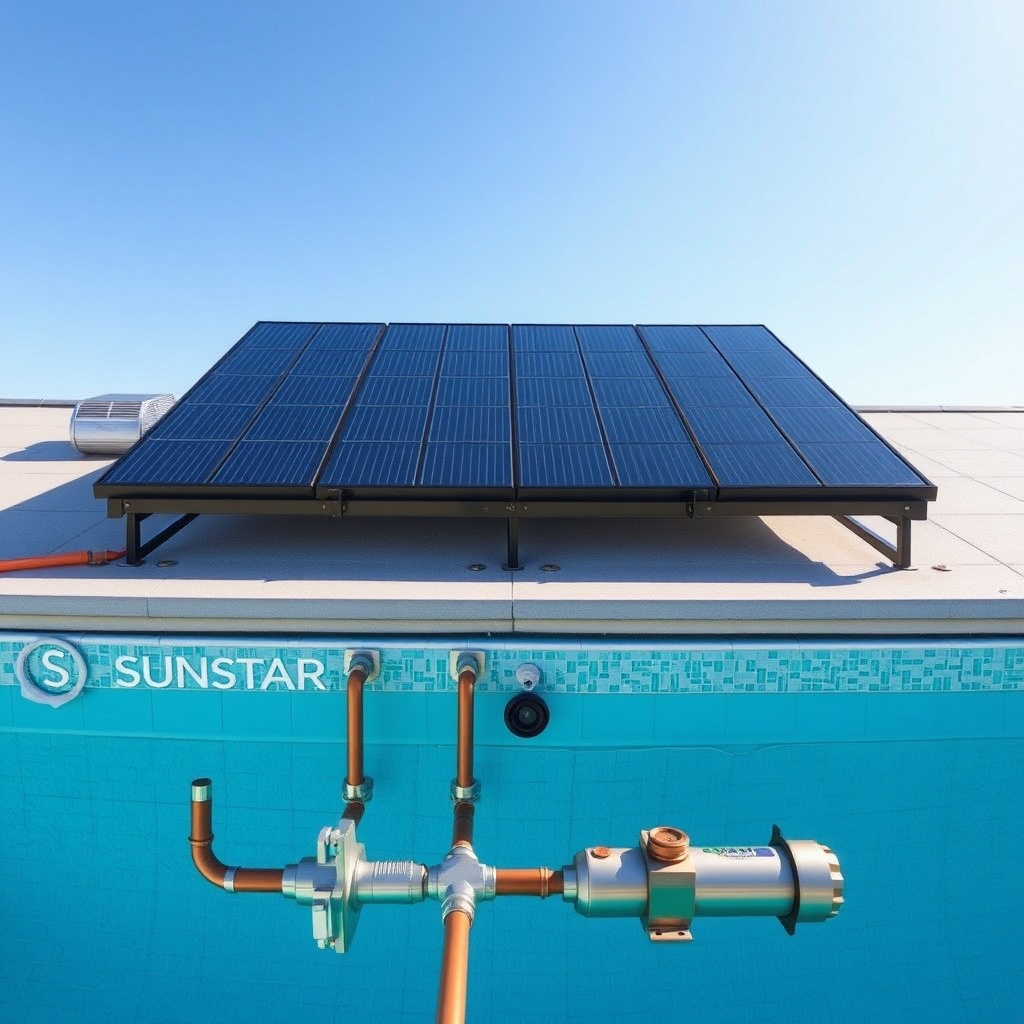
2. How Do Flow Rate and Temperature Delta Affect Heat Exchanger Selection?
SunStar systems are designed for a temperature rise (ΔT) of 5–8°F per pass through the collectors. To maintain this, the heat exchanger must match the total system flow rate. A typical residential system with 6 panels (collector area of 192 sq ft) demands approximately 24–36 GPM. For a plate heat exchanger, the required heat transfer surface area can be estimated by: Area (ft²) = (BTU/hr) / (U × LMTD). For a commercial pool requiring 150,000 BTU/hr with a U-factor of 600 BTU/hr·ft²·°F and LMTD of 10°F, you need 25 ft² of exchange surface. Always consult the SunStar Solar Pool Heater Pressure Drop Analysis: Optimizing System Flow article before finalizing heat exchanger specs.
Flow Rate Recommendations by System Size
| Number of SunStar Panels | Total Flow (GPM) | Recommended Heat Exchanger Type | Min. Heat Transfer Area (ft²) | Pressure Drop Target (psi) |
|---|---|---|---|---|
| 4 (Residential) | 16–24 | Brazed Plate (30 plates) | 12 | 4–6 |
| 6 (Residential) | 24–36 | Brazed Plate (40 plates) | 18 | 4–6 |
| 12 (Small Commercial) | 48–72 | Shell-and-Tube or Gasketed Plate | 35 | 3–5 |
| 24 (Large Commercial) | 96–144 | Multiple Plate Heat Exchangers in Parallel | 70+ | 2–4 |
3. What Are the Best Heat Exchanger Materials for SunStar Systems?
SunStar collectors typically use copper headers and aluminum absorber plates. For the heat exchanger, copper or titanium plates are recommended. Copper provides excellent thermal conductivity (401 W/m·K) and is cost-effective, but can be vulnerable to aggressive pool chemistry (low pH or high chlorine). Titanium resists corrosion in saltwater systems but costs 3–4 times more per square foot. In commercial installations with chlorinated water above 3 ppm free chlorine, a titanium brazed plate heat exchanger is the standard. Always check the SunStar Solar Pool Heater Pump Sizing Guide: Choosing the Right Flow Rate to ensure the pump pressure matches the exchanger’s design.
4. Does Heat Exchanger Location Affect System Performance?
Yes. The heat exchanger should be installed as close as possible to the pool pump and filter to minimize head loss. Ideally, the exchanger is placed after the filter but before the solar supply line. For SunStar systems with a roof-mount tilt, the elevation change can add 0.43 psi per foot of head. The SunStar Solar Pool Heater Roof Mount Tilt Angle Optimization: Best Summer and Winter Settings article provides detailed guidance on accounting for elevation when sizing piping and exchanger placement. A typical 10-foot elevation gain requires a pump capable of 4.3 psi additional head, which must factor into the exchanger’s pressure drop budget.
5. What Owners Say About Pairing Heat Exchangers with SunStar Collectors
Pool owners and commercial facility managers report that properly matched heat exchangers reduce annual gas consumption by up to 60% compared to standalone gas heaters. A common note from users with residential 6-panel arrays is that the water temperature rises 1.5°F per hour on sunny days when the exchanger is sized correctly. On the other hand, several owners who attempted to reuse an old copper tube-in-tube heat exchanger from a different brand found that the pressure drop increased from 5 psi to 12 psi, causing the pump to cavitate. One commercial pool operator in Florida stated, “After switching to a plate exchanger designed for the SunStar flow of 60 GPM, our maintenance calls dropped by 80%.” Another owner using a ground-mount setup emphasized the importance of tilt optimization, referencing the SunStar Solar Pool Heater Ground Mount Tilt Angle Optimization: Best Summer and Winter Settings guide to ensure consistent flow through the exchanger year-round.
6. Frequently Asked Questions About Heat Exchangers and SunStar Systems
Q1: Can I use a standard pool heat exchanger with SunStar collectors?
Only if the pressure drop at the design flow rate stays below 6 psi. Most standard exchangers are designed for high-flow gas heaters (60-80 GPM). For SunStar’s lower flow (4–6 GPM per panel), you need a “solar-optimized” plate exchanger with fewer plates or a smaller shell.
Q2: How do I calculate the exact heat exchanger size for a 10-panel system?
First, find the total BTU requirement: Pool volume (gallons) × 8.34 × desired ΔT. Then divide by (U-factor × LMTD). Example: 20,000 gallons wanting to raise 10°F per day equals 1,668,000 BTU. With a 6-hour solar window, hourly requirement is 278,000 BTU. A clean plate exchanger with a U of 600 and LMTD of 10°F needs approximately 46 ft² of surface.
Q3: Is a brazed plate or shell-and-tube better for SunStar systems?
Brazed plate is recommended for residential and small commercial (up to 50 panels) because it offers 3–5 times higher heat transfer per unit volume, lower hold-up volume, and easier cleaning. Shell-and-tube is more robust for very large commercial arrays (100+ panels) with dirty water.
Q4: What happens if the heat exchanger restricts flow below 3 GPM per panel?
The SunStar collector efficiency drops significantly because the water stagnates inside the absorber tubes, leading to overheating (over 200°F) and potential damage to the glazing or manifold seals. The pump will also work harder, reducing its lifespan.
Q5: How often should I clean the heat exchanger plates for SunStar systems?
For residential installations on municipal water, every 2–3 years is sufficient. For commercial pools or water with high hardness (>300 ppm calcium), annual cleaning with a non-abrasive brush and mild acid solution (5% muriatic acid) is recommended. The SunStar Solar Pool Heater Controller Smart Grid Integration: How to Connect and Program guide can help you monitor flow rates to detect fouling early.
Q6: Do I need a bypass valve around the heat exchanger?
Yes. A manual 3-way bypass valve allows you to isolate the exchanger for cleaning or winterization without shutting down the entire pool circulation. It also enables flow adjustment during startup to prevent thermal shock to the plates.